If you run a website, manage SEO for clients, or have ever added an FAQ section to a page hoping it would appear as an expandable block in Google Search, this update is directly relevant to you. On May 7, 2026, Google quietly added a deprecation notice to its FAQ structured data documentation and, with that, closed a chapter of search optimization that shaped how content was created for years.
No blog post. No press release. No official explanation. Just a notice at the top of a developer documentation page. That is how Google ended FAQ rich results.
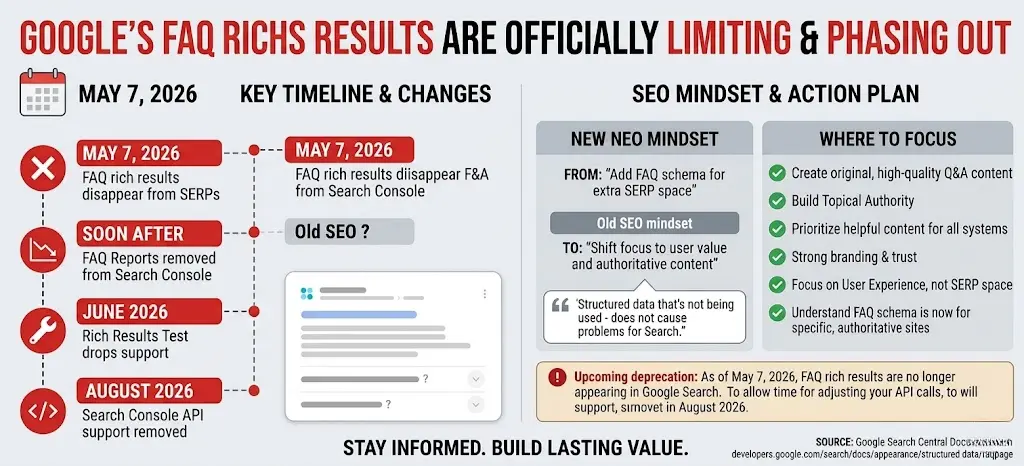
As of May 7, 2026, FAQ rich results are no longer appearing in Google Search. We will be dropping the FAQ search appearance, rich result report, and support in the Rich results test in June 2026. To allow time for adjusting your API calls, support for the FAQ rich result in the Search Console API will be removed in August 2026.
What Were FAQ Rich Results, Exactly?
Introduced in 2019, FAQ rich results were the expandable question-and-answer dropdowns that sometimes appeared directly beneath a search result. A user could click to read short answers without visiting the website at all. For SEO professionals, this was extremely valuable real estate.
When implemented correctly, FAQ schema markup dramatically increased how much visual space a single listing occupied on a results page. Pages with active FAQ rich results consistently saw click-through rates improve by 2x to 3x compared to standard listings. For competitive categories like healthcare, legal services, e-commerce, and SaaS, FAQ schema became standard practice industry-wide. By 2022, almost every SEO checklist included FAQPage markup as a default recommendation.
FAQ rich results gave websites free SERP real estate. A standard listing occupies two lines. An active FAQ result could expand to six to eight lines, pushing competitors further down the page without spending anything on ads.
Fig 1. What FAQ rich results looked like before May 7, 2026 versus what Google shows now. The ranking position is unaffected — only the visual display treatment changed.
This Did Not Happen Overnight: The Full Timeline
The May 2026 announcement was not sudden. It was the final step in a deliberate phase-out that Google began nearly three years ago.
Why Did Google Actually Do This?
Google published no formal explanation, which is frustrating but consistent with how it handles feature deprecations. Reading the available signals from the SEO community and Google’s broader behavior, two factors most likely drove this decision.
The first is abuse. The widespread adoption of FAQ schema brought significant manipulation with it. Websites created low-quality, artificial FAQ sections purely to occupy more SERP space, not to answer genuine user questions. Irrelevant questions, misleading answers, and templated content became so common that the feature stopped serving its original purpose. Google has a clear pattern of retiring features that get gamed at scale, and FAQ rich results fit that pattern precisely.
The second factor is the shift toward AI-driven search. Google’s AI Overviews now handle much of the direct question-answering that FAQ snippets used to facilitate. Maintaining a separate display format for the same job, especially one being abused, made less strategic sense as the product evolved.
What Actually Changes for Your Website
| What Changed | What Did NOT Change |
|---|---|
| FAQ expandable dropdowns are gone from all Google Search results | Your organic ranking positions are completely unaffected |
| FAQ rich result report disappears from Search Console in June 2026 | FAQPage is still a valid Schema.org type — it is not deprecated |
| Rich Results Test stops validating FAQ markup in June 2026 | Google will continue using FAQ structured data to understand your pages |
| Search Console API stops returning FAQ data in August 2026 | Other search engines may still process and display FAQ markup |
| Government and health site exemption is also removed | FAQPage schema can still aid AI Overview citations and entity recognition |
The most important distinction: This is a display change, not a ranking change. Google confirmed it will continue using FAQ structured data to understand page content. If your page ranked 4th before May 7, it still ranks 4th. What you lose is the expanded visual treatment that sometimes made that 4th result look more prominent than listings above it.
Pages that relied heavily on FAQ rich results for their click-through rate should be monitored closely. Pages where FAQ schema was pulling significant impressions may see a real CTR drop. SEO teams should track organic sessions, impressions, and click-through rate for affected pages for at least 6 to 12 weeks after May 7.
Fig 2. Google’s three-date deprecation roadmap for FAQ rich results. Actions required before June and August 2026 are highlighted for SEO teams and developers.
Should You Remove FAQ Schema From Your Site?
No — and this is where a lot of advice circulating right now gets it wrong.
Google itself confirmed there is no need to proactively remove FAQ structured data. Markup that is not generating a rich result does not harm your site. More importantly, Google stated that it will continue using FAQ structured data to understand pages better, even without displaying the rich result. Pages that Google clearly understands are more likely to appear in AI Overviews, be cited in AI-generated responses, and connect to relevant entity signals that AI retrieval systems use.
Google explicitly said it will keep using FAQ data for page comprehension. Pages that are clearly understood by Google get retrieved for relevant queries, cited in AI Overviews, and contribute to entity recognition signals. Removing FAQ schema now means removing a comprehension layer that costs nothing to keep.
Schema Types Still Worth Implementing in 2026
Structured data still matters and still produces rich results in Google Search. These types continue to generate active SERP enhancements and deserve proper implementation on relevant pages.
What You Need to Do Before August 2026
| Action | Deadline | Priority |
|---|---|---|
| Monitor CTR and organic sessions for pages that had FAQ rich results | Ongoing from now — track for 6 to 12 weeks | High |
| Update Search Console dashboards to remove FAQ appearance filter reliance | Before June 2026 | High |
| Export historical FAQ rich result performance data from Search Console | Before August 2026 | Medium |
| Update any automated API pipelines pulling FAQ rich result data | Before August 2026 | High |
| Audit FAQ content quality — keep it for users and AI comprehension, not SERP features | No hard deadline — recommended now | Low |
| Keep FAQPage schema markup in place unless you have a specific reason to remove it | No action needed — do not remove | None |
Frequently Asked Questions
No. Google confirmed that structured data not generating a rich result does not harm your site. Removing FAQ schema does not improve rankings, speeds, or any other metric. If anything, keeping it maintains the comprehension layer Google uses to understand your page, which matters for AI Overview eligibility. There is no upside to removing it unless you are cleaning up pages where the FAQ content itself was low quality and written only to trigger a SERP feature.
No. This is a display change, not a ranking signal change. Your position in organic search results is determined by relevance, authority, and content quality — not by whether you had FAQ dropdowns showing. What may change is your CTR if you were getting a significant share of clicks from the expanded FAQ display. Pages that depended on that visual prominence for traffic should be monitored closely over the next 6 to 12 weeks.
In June 2026, Google will remove the FAQ search appearance filter and the rich result report from Search Console. If you have dashboards or manual reporting workflows using these, they will stop returning data. Before June, export any historical FAQ performance data you want to preserve. Before August, update any automated API integrations that pull FAQ rich result data from the Search Console API, because those calls will break when API support is retired in August 2026.
Only if the content was written primarily to trigger the SERP feature rather than to help users. FAQ sections that genuinely answer real questions your audience is asking remain valuable — for user experience, for AI Overview citation eligibility, and for helping Google understand your page’s topic coverage. FAQ sections that consist of keyword-stuffed, templated, or irrelevant questions written purely for SERP real estate should be rewritten or removed, because they were not serving users to begin with.
Google has not coordinated this deprecation with other search engines. Bing and other search engines make independent decisions about which structured data types they process and display. FAQPage is still a valid Schema.org type, and other search engines may continue to use it. This is one more reason not to rush to remove FAQ schema from your site — losing it from Google’s display does not mean losing all potential value from other search environments.
The Bottom Line
Google’s May 2026 update ends FAQ rich results as a display feature. It does not end FAQ content, structured data, or the underlying value of helping search engines understand your pages clearly.
The SEO playbook from 2019 — implement schema, capture the dropdown, watch CTR rise — is finished. The 2026 playbook is simpler and more durable: create content that genuinely answers real questions, mark it up properly, and build the kind of authoritative presence that AI systems reach for when users ask something in your category.
That is harder than installing a schema plugin. But it is also the kind of work that cannot be deprecated with a single documentation notice.