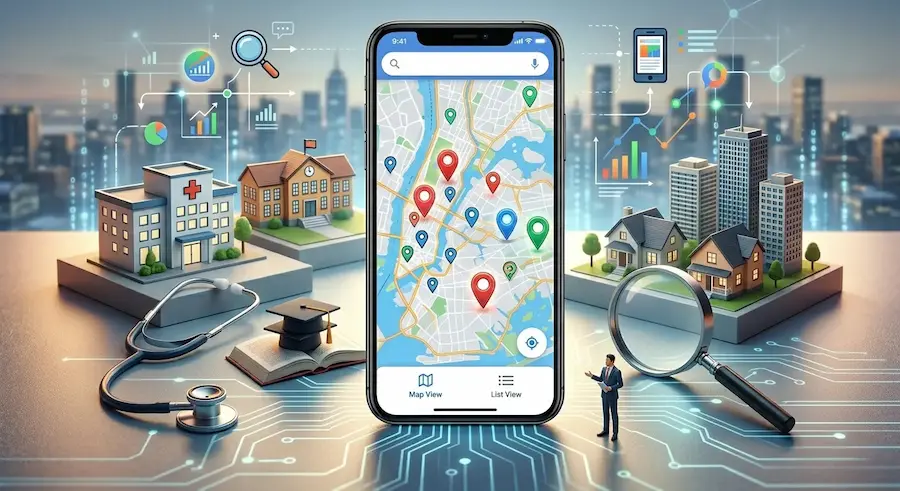
This is the situation that is confusing, and in some cases alarming, hundreds of clinic owners, school administrators, and real estate agencies across the US, UK, and Europe right now.
The local pack you optimised for in 2022 or even 2024 is not the same local pack showing in 2026. Today, a single local search can surface an AI-generated answer block listing businesses pulled from various sources, a traditional local pack showing a completely different set of businesses, and a “Dive Deeper in AI Mode” option revealing yet another set of results.. That is three versions of “the best local business” in a single query.
If your optimisation strategy has not caught up with that reality, you are not just losing rankings. You are becoming invisible to the people most likely to book, enrol, or buy. This article breaks down exactly what has changed, what it means for specific industries, and what you need to prioritise right now.
What the AI Local Pack Actually Looks Like in 2026
Most business owners, and even some marketers, are still operating with an outdated picture of what Google actually shows on a local search result page.
Ranking number one in the local pack is still valuable, but it is now visually buried under AI Overviews and ads. The traditional three-listing map unit that used to dominate the top of local results is now one of several competing elements on the page.
Google’s AI Overviews now appear for a significant portion of search queries. For broad informational queries such as “how to choose a dentist” or “what does a real estate agent do,” AI Overviews often provide direct answers that reduce clicks to websites entirely. For transactional and near-me queries, however, the traditional local pack and Google Maps listings remain prominent.
So the impact depends heavily on the type of query. If someone searches “orthodontist near me” or “primary school open day Birmingham,” the map pack still shows. But if they search “best clinic for knee pain” or “how to choose a real estate agent in London,” an AI Overview may absorb that click before the person ever sees your listing. That distinction matters enormously for how you structure your content strategy.
The Zero-Click Problem Is Real
The new changes on the SERP in the US are causing significantly fewer clicks and call-throughs from Google Business Profiles. If you want to survive the zero-click reality of 2026, you can no longer rely on a single, highly optimised listing. The AI layer is not just an addition to what was already there. It is narrower, more selective, and based on different criteria than the old map pack.
Fig 1. The four-layer structure of a 2026 local search results page, and where your business needs to appear.
How the Ranking Signals Have Shifted
Google’s March 2026 core update brought the most significant recalibration of local ranking factors in recent memory. Here is what the data and practitioners are reporting.
GBP Completeness Is Now a Hard Ranking Factor
Google’s internal Google Business Profile completeness score has become a more explicit ranking input. Profiles missing service listings, photos, attributes, or Q&A content now face a measurable penalty relative to complete competitors.
This is no longer soft guidance. For clinics, this means listing every treatment. For schools, it means listing programmes, age groups, and term dates. For real estate agencies, it means service areas, property types handled, and active listing attributes.
Review Quality Has Overtaken Review Volume
Prior to the March 2026 update, raw review counts correlated strongly with local pack placement. Post-update data shows Google now weighting review recency and owner response rate more heavily. Businesses with stale review profiles but high counts dropped; active responders with moderate counts gained.
This is where most businesses get it wrong. They ran a review campaign in 2022, collected 80 five-star ratings, and have not actively managed their review presence since. That looks impressive. But Google’s current algorithm sees a business that stopped engaging with its customers two years ago.
Google’s systems now parse review content for relevance, identifying mentions of specific services, location references, and authentic customer experiences. A dozen detailed, context-rich reviews from genuine customers now outperform fifty generic ratings with no text.
Proximity Signals Got Tighter
Google tightened proximity signals in competitive categories, reducing the radius within which non-proximate businesses can rank for high-intent local queries. Businesses outside the immediate service area saw pack drops. For real estate agencies, if your office is in one postcode but you have always ranked for queries two or three boroughs away, that visibility may have narrowed. The fix is not to move offices. It is to create location-specific content and acquire local citations in the areas you serve.
Fig 2. How Google’s local pack ranking signals have shifted before and after the March 2026 core update.
What This Means for Clinics, Schools, and Real Estate Businesses
Clinics and Healthcare Providers
Healthcare searches have very high intent. Someone searching “physio clinic near me” or “private GP London” wants to book, not read a blog post. That is good news because transactional queries still trigger the map pack prominently.
The risk for clinics is threefold. First, Google has replaced call buttons with images for several industries, and the same trend that hit dentists earlier has now spread across healthcare categories. Your patients may see your listing and a photo carousel but no direct call button.
Second, incomplete GBP profiles are being filtered more aggressively. If your clinic has not listed every service, uploaded recent photos, and kept hours and attributes current, you are losing ground to competitors who have.
Third, E-E-A-T matters enormously in healthcare. Google rewards content clearly tied to real people with demonstrable expertise. Author bios matter. Your “About” page matters. Reviews, credentials, and social proof all feed into how Google evaluates whether your site deserves to rank. Clinics with no named practitioners on their website are at a real disadvantage.
List every service and condition you treat in GBP. Upload photos of treatment rooms, staff, and exterior monthly. Add practitioner names and credentials to the website with individual bio pages. Request detailed reviews that mention the specific treatment and staff member. Implement LocalBusiness and MedicalBusiness schema on your website.
Schools and Educational Institutions
Schools face a different challenge. Most searches for schools are higher-funnel and informational: “best primary school in Cheltenham,” “IB schools near me,” “private secondary schools Manchester.” These queries are exactly the type that now attract AI Overviews, which means the click may never reach your website.
To get your school cited in an AI Overview response, you need clear, structured, factual content on your website that answers the questions parents are actually asking: curriculum overview, admission process, fee structure, extracurricular provision, inspection results. Write it in clean, direct language that an AI system can easily parse and summarise.
AI systems rely on clear, well-structured business information that is easy to interpret, consistent details and mentions across the web, and recent, detailed customer feedback that reinforces trust and relevance. Instead of simply ranking pages, AI is sorting local business entities and surfacing only those it can confidently trust.
For schools, parent reviews on Google are an underused asset. A detailed review that says “excellent STEM programme, very supportive pastoral care, great communication from the head teacher” does far more for your local SEO than five-star ratings with no text.
Create dedicated pages for each year group, programme, and key parent query. Add FAQ schema to pages answering common admissions questions. Run a structured review programme targeting parents after key events. Build citations on education directories. Keep your GBP updated with term dates, open days, and school news posts.
Real Estate Agencies
Real estate is one of the most competitive categories in local search, and it has been hit hard by two concurrent trends: tighter proximity signals and the rise of paid placements.
Local pack ads were visible on just 1% of tracked reports in early 2025. By January 2026, almost 22% of reports were showing them. For real estate in major cities, that figure is likely even higher. Organic listings are being pushed further down by both AI Overviews and an expanding paid layer.
Cookie-cutter location pages with only the city name swapped out are being filtered out of results more aggressively than before. Each location page needs original content: local market insights, recent sales data, area guides, school catchment information. Content that a buyer or landlord in that area would actually find useful.
Build genuinely unique content for each location page with market data and local guides. Claim and optimise GBP profiles for every branch location individually. Run Local Services Ads alongside organic optimisation. Target long-tail conversational queries in blog content. Use RealEstateListing and LocalBusiness schema markup.
The Signal-Fit Concept: Why a Checklist Is No Longer Enough
Based on a comprehensive analysis of 8.7 million Google Business Profiles, the secret to dominating the local pack is no longer a universal checklist, but what is now being called “Signal-Fit”: a hyper-localised alignment between a business listing and the specific industry expectations, query patterns, and user signals for your exact category and location.
In plain terms: a dental clinic in Manchester and a dental clinic in Miami need different optimisation approaches, even if the technical checklist looks the same. The competitor landscape, review velocity, local citation ecosystem, and query patterns are different. Google’s AI is matching businesses to queries based on a far more nuanced model than it was two years ago.
Here’s the real issue: most businesses fail to rank in the local pack not because of a lack of reviews or links, but because Google has determined they are not “eligible” for the specific query. Eligibility comes from the alignment between your GBP category, your business name, your website content, and the signals Google associates with that query. If your GBP primary category is too broad, or your website content does not reinforce the specific services and location signals Google expects, you will fail the eligibility check before ranking factors even come into play.
Fig 3. The Signal-Fit model: the five signals Google’s AI checks before determining a business’s eligibility to rank in the local pack.
The Paid Search Reality in 2026
This is the part many organic-only SEO practitioners are reluctant to say, but the data is clear. Google is definitely moving toward a pay-to-play model. Clients who are running ads are getting a better ROI than previously, because the ads have better placement and contain features like call buttons that organic listings are losing.
For clinics, schools, and real estate businesses, a hybrid strategy combining strong organic local SEO with Local Services Ads is the most defensible approach in 2026. This is not a permanent surrender of organic territory. It is a recognition that the SERP has changed, and that waiting for organic positions to recover while paid results claim the click-driving features is not a rational strategy.
Worth noting: High-resolution, frequently updated photos are no longer optional. Google’s AI now reads your photos to categorise your services. Start working on video assets too. A profile with stale, low-quality images sends a negative signal to both Google’s algorithm and the potential patients, parents, or buyers who do land on your listing.
A 2026 Local SEO Checklist That Actually Reflects Current Reality
Here is what a current, properly maintained local SEO operation looks like. Run through this for every location you operate in.
Fig 4. The three-pillar local SEO checklist for 2026, covering GBP, website signals, and off-site presence.
Frequently Asked Questions
This is a common situation in 2026. Google has replaced call buttons with images for several industries, and a business can rank well but still see call volume drop. Ranking and clicking are now two different things. The solution involves adding Local Services Ads to recapture the direct call functionality, and ensuring your GBP photos and content are compelling enough to drive action even without a call button.
Very important, and more so than a year ago. Google’s internal GBP completeness score became a more explicit ranking input after the March 2026 core update. Profiles missing service listings, photos, attributes, or Q&A content face a measurable penalty relative to complete competitors.
Yes, but the nature of what matters has changed significantly. Post-March 2026 update data shows Google weighting review recency and owner response rate more heavily than raw review volume. Businesses with stale review profiles but high counts dropped; active responders with moderate counts gained. Aim for recent, detailed, service-specific reviews and respond to every one.
The AI local pack refers to the AI Overview or AI-generated business recommendations that appear above or alongside the traditional three-listing map pack. AI Overviews synthesise data in real-time using Google’s Gemini model, pulling from Google Business Profiles, Google Maps, Reddit, Yelp, and other sources. It is not just about where you rank anymore, but whether you show up at all in these AI-driven summaries.
Yes. For transactional and near-me queries, traditional local pack results and Google Maps listings remain prominent. A search for “dentist near me” or “primary school open day Birmingham” still surfaces the familiar map pack. The key is combining solid GBP management with content that earns AI Overview mentions for your informational queries, and treating the whole thing as an ongoing operation rather than a one-time setup.
To appear in AI Overviews for local queries, your business needs a complete and active GBP, consistent citations across the web, detailed recent reviews, and well-structured website content with schema markup that AI systems can easily parse. AI systems rely on clear, well-structured information and consistent signals across the web to confidently trust a business enough to surface it.
The Bottom Line
The local pack has not disappeared. Google has not made local SEO irrelevant. What has happened is that the path from search to phone call has become longer, more competitive, and more fragmented. There are now multiple surfaces to optimise for, multiple AI layers filtering which businesses earn visibility, and a growing paid layer capturing the click-driving features that organic listings used to own.
For clinics, schools, and real estate businesses, the message is consistent: you cannot afford to treat local SEO as a one-time setup. The businesses winning in 2026 are the ones treating their Google presence as an active, ongoing operation. Signal-fit, GBP completeness, review management, structured data, and location-specific content are the levers that matter now. Pull them deliberately and consistently.
Not Sure Where Your Local SEO Stands Right Now?
If your Google calls are dropping, your local pack position has slipped, or you are not sure whether your current strategy is built for how search works today, now is the time to audit. We work with clinics, schools, real estate agencies, and other location-based businesses across the US, UK, and Europe.