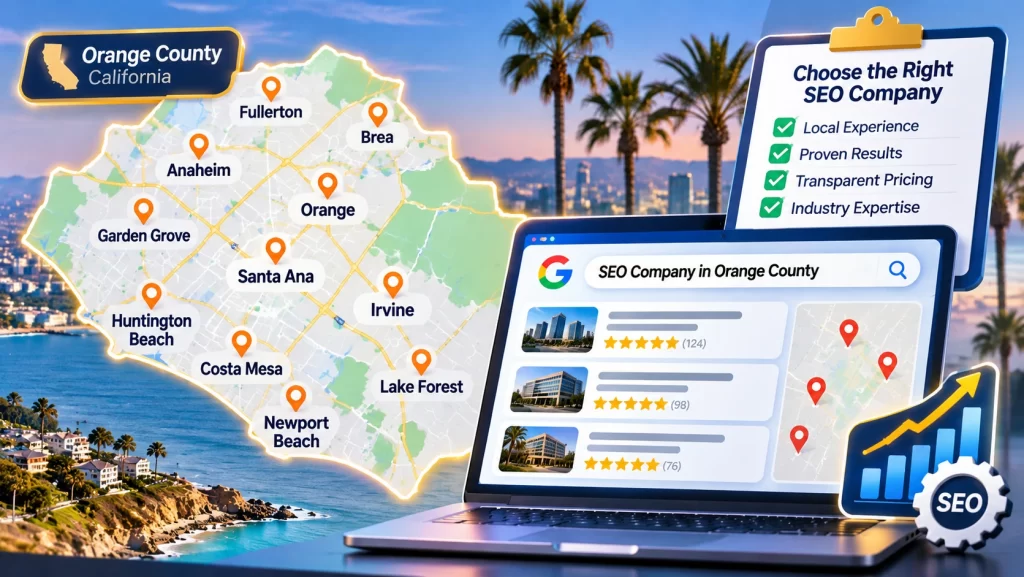
Orange County is one of the most crowded local markets in the country to be found in. About 3.15 million people live here, and in 2023 the county had 106,961 employer establishments plus 323,247 nonemployer businesses, according to the U.S. Census Bureau. A dentist in Irvine, an immigration attorney in Santa Ana and a wedding venue in Laguna Beach are all competing for the same few spots on a phone screen. Choosing an SEO company in Orange County is therefore a decision about who will fight for those spots, how honestly they will report on it, and whether they understand that Orange County is not one market.
This guide explains how local search works, what Orange County SEO services should include, how competition differs between cities, how to evaluate an agency and what to measure. Statistics are labeled by source, date and geography. Where the evidence runs out, we say so, and we separate our own analysis from verified research.
The Orange County SEO Landscape
BrightLocal’s July 2026 survey of 1,227 US consumers found that 84% had searched for a local business in the previous three months, 75% chose in under 30 minutes, and 73% of local searches began on a mobile device (BrightLocal). These are national figures covering every industry, not Orange County measurements. They are still the best public evidence of how people behave. Locally, Census data show 97.9% of Orange County households have a computer and 95.0% a broadband subscription (2020–2024), so online discovery is the norm here.
Orange County is also dense and affluent: the Census Bureau counts 4,019.7 people per square mile (2020) and a median household income of $116,289 (2020–2024, in 2024 dollars). Our analysis is that this means many businesses chase the same service keywords, and customers can compare nearby options in minutes, so trust signals such as reviews and accurate listings carry real weight.
Why Your Choice of SEO Company Matters
The shortlist is short, and reviews decide who stays on it. In the same BrightLocal study, 65% of consumers who rejected a business did so for a review-related reason: negative reviews, a low rating, or missing and outdated reviews. A weak SEO partner can cost you in three ways beyond the fee: months of work on the wrong keywords, risky tactics that invite a Google penalty or profile suspension, and reporting that hides the lack of results.
How Local Results Are Decided
Google says local results rely mainly on relevance, distance and prominence (Google Business Profile Help). You cannot move your office, so distance is fixed for each searcher. Relevance and prominence are the work: an accurate and complete Google Business Profile, strong and recent reviews, a website that matches the search, and mentions across the web. Organic results below the map pack follow more traditional signals such as content quality, technical health and links. A good Orange County SEO company works on both.
What Orange County SEO Services Should Include
Orange County SEO services vary widely in scope. Use this table to see what a serious engagement covers and what it should produce.
| Service | What It Covers | What You Should See |
|---|---|---|
| SEO audit and competitor analysis | Technical health, content gaps, profile accuracy, who actually ranks for your target searches | A written audit with a prioritized fix list, not a generic report |
| Local keyword research | Search intent by service and location, including “near me” and city-level searches | A keyword-to-page map explaining why each term was chosen |
| Google Business Profile optimization | Categories, services, hours, photos, posts, Q&A, one profile per real location | A corrected, fully completed profile and a record of changes |
| On-page and content | Service pages, location pages with genuinely local information, FAQs | New or rewritten pages written for patients or customers first |
| Technical SEO | Crawling, indexing, speed, mobile layout, canonical tags, structured data | A fix log with before-and-after checks in Search Console |
| Citations and listings | Consistent name, address and phone data across major platforms and directories | A cleanup report listing conflicts found and fixed |
| Reviews and reputation | A compliant review request routine and a reply process | A workflow you control, with no incentives or review gating |
| Link building and local authority | Earned mentions from relevant local sites, associations, press and partners | A list of links earned, with URLs. Never an unexplained “links built” count |
Orange County Is Not One Search Market
A search for “dentist Orange County” and a search for “dentist Tustin” behave differently. The county-wide query is broad, competitive and often answered by directories. The city-level or “near me” query is usually resolved by proximity, which favors businesses physically close to the searcher. Google also says it measures distance from the location named in a query or, if none is named, from what it knows about the searcher’s location. So a business in Fullerton may struggle to appear for searches made in Mission Viejo regardless of how good its website is.
The table below is our analysis of how competitive conditions plausibly differ, based on how local search works and the county’s commercial geography. It is not measured data, so test it against your own keywords before building strategy on it.
| Area Type (Examples) | Likely Search Pattern | Strategy Implication |
|---|---|---|
| Business and commercial hubs (Irvine, Costa Mesa, Newport Beach, Fullerton) | Dense competition in professional, healthcare and real estate categories; many multi-location firms | Specificity wins: narrow services, strong reviews, and distinct location pages for each office |
| Tourism and hospitality centers (Anaheim, Buena Park, Huntington Beach, Laguna Beach, Dana Point, San Clemente) | Visitors and residents search differently; “open now” and “near me” intent is strong | Accurate hours, photos and menus or service details matter more than long articles |
| Dense, diverse urban markets (Santa Ana, Garden Grove, Westminster) | Language and community-specific search may matter more | Test demand for Spanish and other community languages before investing (see below) |
| Suburban family markets (Mission Viejo, Laguna Niguel, Lake Forest, Yorba Linda, Brea, Tustin, Orange) | Service-area searches and “near me” intent dominated by proximity | Strong reviews and a nearby, well-presented office often outweigh a larger content budget |
Location Pages: Only Where They Are True
Create a page for a city only if you have a real office there or a genuine service-area reason, and only if the page says something useful: the address, parking, the team, neighborhoods served and local booking details. Duplicating a page and swapping “Irvine” for “Brea” helps neither customers nor Google. Google’s own guidelines also allow only one profile per real location, so do not create profiles for cities where you have no staffed address.
Multilingual Search Opportunities
Language is a real feature of this market. Census data show 45.9% of Orange County residents aged 5+ spoke a language other than English at home in 2019–2023 (46.4% in 2020–2024), against 22.0% nationally (2019–2023). Hispanic or Latino residents were 34.5% of the population and Asian residents 25.0% (2020–2024 estimates).
Fig 1. Census data show the language mix; they do not show search volume in any language.
That is a demographic fact, not proof that Spanish- or other non-English-language SEO will pay off for every business. Our analysis: it makes sense when your service genuinely serves those communities and you can deliver in the language, including the phone call, the office visit and the reviews. Translated pages with an English-only front desk create a worse experience than no translation at all. Measure demand with Search Console impressions and call data before committing budget.
Google Business Profile and Reviews
For most local searches, your Google Business Profile is the first thing a customer sees. Google’s guidelines ask for your real-world business name, as few categories as accurately describe you, one profile per real location, and accurate hours. Adding a city or keyword to the business name can get a profile suspended, so an agency that suggests it is a red flag.
Reviews do double duty. BrightLocal’s 2026 Local Consumer Review Survey (US consumers, all local industries) found that 97% read reviews for local businesses and 71% use Google to do so. Build a steady, honest review routine: ask soon after the job or visit, link straight to the review page, never offer incentives, and never screen out unhappy customers. In regulated fields such as healthcare and law, keep review replies free of client or patient details.
How Different Orange County Industries Approach Local SEO
These are illustrative scenarios based on how each type of search works. They are not client results or measured benchmarks.
| Business Type | What Customers Search For | Where to Focus |
|---|---|---|
| Dental or medical practice (Healthcare SEO) | “Dentist near me,” urgent and same-week appointments | Accurate hours, one profile per clinic, treatment pages, privacy-safe review replies |
| Law firm (Legal SEO) | Practice-area searches, often with a city, and trust-driven comparisons | Practice-area pages, attorney credentials, local mentions, reviews |
| Real estate agent or broker (Real Estate SEO) | Neighborhood and city searches, such as homes or agents in a specific community | Genuinely local neighborhood content, not copied city pages |
| Restaurant or venue (Restaurant SEO) | “Open now,” “near me,” menus and reservations | Hours, photos, menu and booking links, review volume |
| B2B or software company in Irvine (SaaS SEO) | Problem and comparison searches with no local intent | Content and technical SEO, since the map pack matters little |
Local SEO vs Traditional Organic SEO
| Factor | Local SEO | Organic SEO |
|---|---|---|
| Where it shows | Map pack and local results | Standard blue-link results |
| Key inputs | Profile accuracy, reviews, proximity, citations | Content, technical health, links |
| Best for | Offices, clinics, restaurants, home services | Research-driven queries, national or multi-city reach |
| Typical queries | “near me,” city and service searches | Questions, comparisons, guides |
Most Orange County businesses need both, weighted by how customers find them. A single-location restaurant should lean on its profile and reviews. A software company in Irvine selling nationally needs organic content far more than map visibility.
How to Choose an SEO Company in Orange County
Evaluate any SEO company in Orange County against these criteria, in roughly this order of importance.
- Relevant experience. Ask for examples in your industry or a comparable local market, and how they apply to your situation. Do not accept screenshots without context.
- Understanding of local competition. They should be able to describe who competes for your searches before you hire them, and in which cities.
- Technical and content depth. Ask who handles crawl issues, structured data and page writing, and see sample deliverables.
- Profile and review expertise. They should know Google’s guidelines well enough to explain why you should not add a keyword to your business name.
- Reporting that goes past rankings. Expect calls, form leads and, where possible, booked appointments or sales by source.
- Realistic timelines. Early work such as profile fixes and tracking can show quickly. Ranking and lead growth usually take months and vary by market.
- Clear pricing and ownership. You should own your website, profile, analytics and tracking numbers, in writing.
Warning Signs
- Guaranteed first-page or number-one rankings. Google controls results, and no agency can promise them.
- Vague deliverables. “Optimization” with no list of work is unaccountable.
- Bulk or purchased links. Low-quality link schemes can harm a site.
- Unverifiable claims. Ask for named clients or references, and be skeptical of vague “300% growth” statements.
- Rank-only reporting. Rankings vary by searcher location and say nothing about revenue.
- No transparency. You should be able to see what was done each month.
Consultant, Agency or In-House?
| Option | Strengths | Limits | Often Suits |
|---|---|---|---|
| Independent consultant | Direct access, often lower cost, flexible | One person’s capacity and skills; continuity risk | Single-location businesses with a modest scope and a clear brief |
| Full-service agency | Broader skills (technical, content, links, reporting) under one roof | Higher cost; quality depends on who is assigned to you | Multi-location firms, competitive categories and larger growth targets |
| In-house | Deep business knowledge and fast execution | Hiring cost, tool cost and narrower expertise | Larger organizations with sustained SEO needs |
No option is best in every case. Many businesses start with an agency or consultant and bring parts of the work in-house as they grow.
Questions to Ask Before Signing
- Who will work on my account, and what are their roles?
- What will you do in the first 90 days, specifically?
- How do you handle reviews without incentives or review gating?
- What does the monthly report show, and can I see a sample?
- Who owns the profiles, analytics and tracking numbers if we part ways?
- What is the contract length and cancellation notice?
Common Mistakes That Limit Local Growth
- Treating the whole county as one keyword. “Orange County” as a single target ignores how proximity decides local results.
- Doorway city pages. Near-identical pages for cities you do not serve add noise rather than visibility.
- Inconsistent business details. Old suites, former phone numbers and duplicate profiles confuse searchers and search engines.
- Ignoring the phone. A missed call from a well-ranked listing is a lost customer, and no SEO fixes that.
- Judging success by rankings. A higher position matters only if it brings enquiries that become customers.
Measure More Than Rankings
| Metric | Where to Find It | Why It Matters |
|---|---|---|
| Profile calls, direction requests and website clicks | Google Business Profile performance | Shows demand for each location |
| Organic traffic to service and location pages | Search Console and analytics | Shows whether the right pages are found |
| Qualified calls and forms | Call and form tracking | Separates real enquiries from spam and existing customers |
| Bookings, sales or cases won | Your CRM or scheduling system | The result that pays for SEO |
| Cost per acquired customer | Program cost divided by attributed customers | Return on investment, if attribution is reliable |
AI Search and the Next Phase of Local Discovery
BrightLocal’s 2026 Local Consumer Review Survey (about 1,000 US adults) reported that 45% of consumers had used AI tools for local business recommendations in the past year, up from 6% the year before. That is a US-wide, all-industry figure. Our analysis, which is not measured data: AI tools draw on the same raw material customers use, including your profile, website, reviews and third-party mentions, so consistent and accurate information is the safest preparation. Strengthen those foundations before chasing a new tactic. We cover the content side in our AI SEO and AEO services.
A 90-Day Implementation Roadmap
| Period | Priorities | Decision Gate |
|---|---|---|
| Days 1–30 | Audit the site, profiles and listings. Set up call and form tracking. Fix hours, categories and duplicates | Can you see calls and enquiries by source? |
| Days 31–60 | Build or rewrite service and location pages with genuinely local details. Start a compliant review routine | Is every claim on the pages true and approved by you? |
| Days 61–90 | Clean up citations, resolve technical issues, validate structured data, begin local link building | Are qualified enquiries rising, and what is next? |
Timing varies with competition and starting point. Be cautious of anyone who promises first-page rankings within a month.
Frequently Asked Questions
Prices vary widely by scope, competition and number of locations, so compare deliverables before totals. Ask for a written scope listing what is included each month. You can review our options on the pricing page.
Profile fixes and tracking can show effects within weeks, while rankings and lead growth usually build over several months. Competitive categories and cities take longer, and no one can responsibly promise a date.
It depends on your service area. A business with offices in two cities should have a strong page and profile for each. A business serving the entire county needs a broader strategy, but should not create city pages without a genuine reason.
Only if you serve Spanish-speaking customers and can serve them in Spanish. Census data show a large multilingual population, but confirm demand through your own Search Console and call data first.
Yes. Local SEO centers on your Google Business Profile, reviews, proximity and citations, while organic SEO centers on content, technical health and links. Most local businesses need both.
It can be, if the agreed targets are meaningful and measurable, and if the agency does not benefit from tactics that put your site at risk. Read the terms carefully and ask what happens if targets are missed.
No. Google determines results, and guarantees are one of the clearest warning signs in this industry.
Conclusion
The right SEO company in Orange County will not start with promises. It will start with questions about your locations, customers and competitors, then show you what it plans to do, how it will measure it and who owns the results. Orange County rewards businesses that are accurate, trusted and easy to contact, and that treat Irvine, Santa Ana and San Clemente as different markets because they are.
Amigo Softtech offers Local SEO, SEO, AI SEO and Pay for Performance SEO, plus industry-specific services for healthcare, legal, real estate and restaurants. If you would like an independent view of where your business stands, request a consultation and tell us your locations and goals.
Not Showing Up in Google Maps?
Get a free local SEO audit and find out why competitors are appearing above you for searches in your area.