
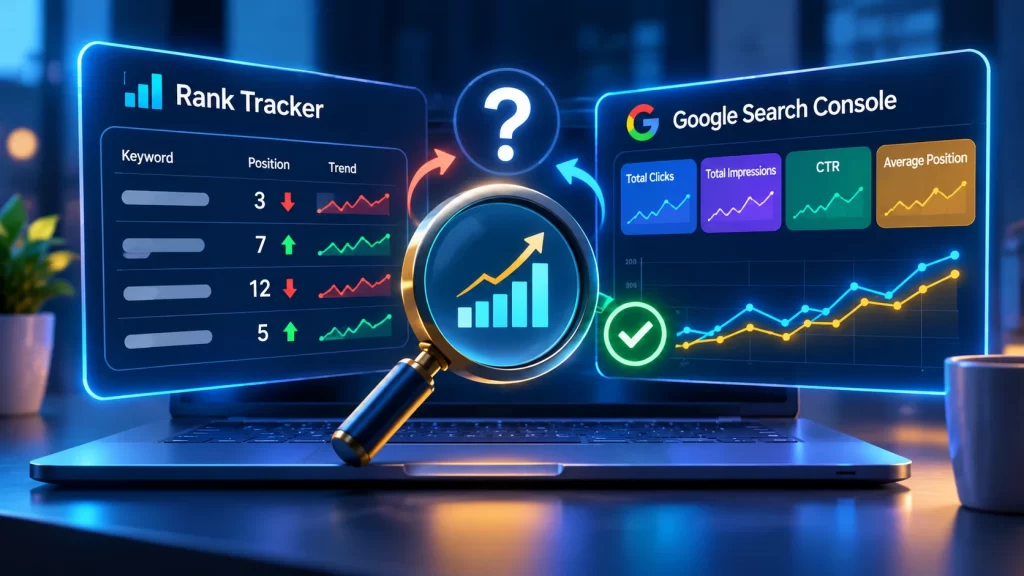
A rank tracker does not tell you where you rank. It tells you where one automated request found you, at one moment, from one place. That is useful evidence, and it can also be wrong in ways that have nothing to do with your SEO. In 2026 the second part got harder to ignore: several rank-tracking vendors reported that Google result pages collected by their tools sometimes looked normal but did not match what the keyword normally returns.
This guide separates what is documented from what is not. It shows you how to check a ranking drop against Google’s own data in Search Console, how to read the numbers you find, and how to explain the result to a client or manager without overclaiming. Figures are from sources checked on 8 November 2026, and vendor figures are labelled as vendor figures.
Documented: vendors including Nozzle, Ahrefs, SEOmonitor and AccuRanker say some of the result pages their tools received were distorted, and they filter or re-fetch them.
Not documented: why it happens. In the sources we checked, Google has made no statement about it. Any explanation beyond that is a vendor’s opinion.
What to do: treat a tracker drop as a question, and confirm it in Search Console before you act.
Why Rank Trackers and Real Rankings Can Differ
Before blaming Google, rule out the ordinary reasons. Most tracker-versus-reality arguments come from here, not from distorted pages.
| Cause of a mismatch | What is happening | How to check |
|---|---|---|
| Location | A national check and a city check are different searches, and local results change by place | Match the tracker’s location to the searchers you care about |
| Device | Mobile and desktop results differ in layout and order | Compare the same device in the tracker and in Search Console |
| Timing | Rankings move through the day, and a tool checks once | Look at a week of checks, not one |
| Counting rules | Some tools count page position, so a map pack or AI block above you pushes the number down | Read the tool’s help page on how it counts |
| Personalisation | Google notes that your own search can differ from the reported average because of search history and similar variables | Do not use a manual search as proof either way |
That last row matters. Your own browser is also one witness, so “I searched and we are still fine” does not settle a disagreement.
What “Poisoned SERPs” Means in Plain English
“Poisoned” is Nozzle’s term, not Google’s. It describes a results page that looks complete and normal but has the keyword’s usual sites swapped out. Nozzle counts a page as poisoned when fewer than half of the keyword’s usual sites appear, where “usual” means sites in the top 10 on at least 60% of baseline pages. Nozzle’s companion study, “Google Plays Dumb,” describes a related fault where a page’s organic results answer only part of the query. Its example is “easy strawberry jam,” where the AI Overview gave a jam recipe while the organic results were about a TV series called Easy.
What One Vendor’s Data Shows
| Finding | Figure | Scope and caveat |
|---|---|---|
| Poisoned page-1 SERPs | 14.3% since 13 Sep 2026, against 0.17% (20 Aug to 9 Sep) | Nozzle, updated 1 Nov. Sample of SERPs Nozzle tracks for customers, 58 countries, 66.7 million judged SERPs |
| Poisoned, pages 1 or 2 | 26.9% against 0.28%. Peak 64.0% on 31 Oct | Same study. The peak is a single day |
| Spells lasting one SERP | About two in three | Same study. Many spells are brief |
| Recovery | 46.9% within three days, 90.4% within two weeks | Same study |
| Organic results ignoring part of the query | 13.2% since 16 Sep, against 0.06%. Peak 39.9% on 28 Sep | Nozzle, “Google Plays Dumb”, updated 1 Nov. 261 million SERPs from 9 Mar to 1 Nov, 52 countries |
Fig 1. One vendor’s measurement of distorted pages. Another vendor’s sample could show a different share.
It shows that trackers can receive pages that differ sharply from a keyword’s own history, and that many spells are short.
It does not show why this happens, who else is affected, or that your site’s ranking was untouched. Nozzle judges each keyword against its own history, so the figures are estimates, and the study is from a company that sells rank tracking.
What the Other Tool Makers Said
The summary below comes from Search Engine Journal’s report (published 23 October 2026), so it is secondary reporting of each vendor’s own statements. Each vendor measures differently, so the numbers are not comparable with each other.
| Vendor | What it said | Caveat |
|---|---|---|
| Ahrefs | It is cleaning up past results that may have been affected, and its filters reject abnormal results and request replacements. It estimates 5% to 20% of results were affected over recent weeks, depending on the provider | The report does not say whether that share is before or after filtering, or which dates it covers |
| SEOmonitor | About 8% of daily Google results were incomplete or incorrect and re-pulled. About 10% of monitored keywords had issues from 9 to 13 Oct, and most Visibility movements were minimal | No averaging period stated for the 8% |
| AccuRanker | It discards shortened pages and re-fetches them. Its sample check flagged 30.2% of desktop keyword-days on 25 Sep and 0.58% on 17 Oct. It stated that Google “has made no statement” | The report does not say whether flagged days will be revised in stored data |
| BrightLocal | It is adding data suppliers so one failure does not halt its data, and said there is no single complete fix | A post by the company’s CEO, not a measurement |
| SerpApi | It deployed an update it expects to reduce instances and is still working on the problem | Statement from a public GitHub issue, 14 Oct |
The practical lesson is that a vendor’s own correction process is part of your data. If a tool has re-processed past results, your old reports may no longer match what you sent last month. Ask your tool provider whether history was revised.
What Google Changed (and What It Has Not Confirmed)
| Date | Event | Who confirmed it |
|---|---|---|
| Sep 2025 | Google stopped supporting the &num=100 parameter, which tools used to fetch 100 results in one request. Tools had to make more requests to see deeper results | Google later confirmed the parameter is not officially supported (Search Engine Roundtable) |
| 13 Sep 2026 onward | Nozzle’s poisoning window begins | Vendor measurement only. No Google statement found |
| 18 to 21 Aug 2026 | August 2026 spam update, 2 days 16 hours | Google announced it. It said the update applies globally and to all languages, and has not said which spam policies it targets (SEO Kreativ, citing Google’s release history) |
| 24 Sep to 8 Oct 2026 | September 2026 spam update, 13 days 16 hours | Google announced it and listed the end on its Search Status Dashboard (Search Engine Journal) |
September 2025: The &num=100 Change
When Google dropped the parameter, Search Console data changed too. Search Engine Roundtable reported that Tyler Gargula’s review of about 320 properties found 87.7% had lower impressions, and 77.6% had fewer unique ranking keywords. Reporters suggested the cause was that scraper impressions were no longer being counted. That is their interpretation, not a Google statement. If you compare 2026 against 2025 in Search Console, mark September 2025 on the chart.
September 2026: Swapped Results, With No Google Explanation
Nozzle’s poisoning window starts on 13 September, and the September spam update ran from 24 September to 8 October. The two overlap. A tracker drop in that period could be a distorted page, a real ranking change, or both. That is why Search Console confirmation matters most in this window.
August 2026: Real Drops Happen Too
Rankings do change for real reasons. SE Ranking’s analysis of 100,000 US keywords across 20 industries, summarised by Relevant Audience, found that the share of top 10 URLs that fell beyond position 100 rose from 9.2% in a July baseline to 16.71% around the August update. That is vendor data, reported second-hand, and it does not say which sites were hit or why.
How to Verify Your Google Rankings in Search Console
Search Console reports what Google recorded for your own site: clicks, impressions, click-through rate and average position. Google docsGoogle’s help page describes average position as the topmost position of your result, averaged across the queries and impressions in the report. It is an average, not a live rank.
- Open Performance, then Search results. Turn on all four metrics: Clicks, Impressions, CTR and Average position.
- Pick two equal periods. Use Compare, for example the last 28 days against the previous 28. The most recent days are often incomplete, so end the range a few days back.
- Filter to the page the tracker flagged. Add a Page filter first, then a Query filter for the keyword, then split by Device and Country.
- Check the same dates the tracker moved. A one-day dip in a tracker should not be compared with a 28-day average.
- Save the view. Export the data or note the filters so someone else can repeat the check.
How to Read What You See
| Pattern in Search Console | Most plausible reading | First thing to test |
|---|---|---|
| Tracker down, Search Console flat | The tracker received a distorted or unrepresentative page, or its location and device differ from your real audience | Wait for the next check and compare settings |
| Position worse, clicks steady or up | New low-ranking queries are pulling the average down | Compare the same query list across both periods |
| Position steady, clicks down | Something above you changed, such as an AI answer, richer features or stronger competing snippets | Look at the live results page on the same device |
| Impressions down, position steady | Lower demand, seasonality, or a lost group of queries | Compare with the same weeks last year |
| Impressions, clicks and position all worse | Probably a real loss of visibility | Check indexing, site changes and the update dates above |
| Query | Period 1: impressions / position | Period 2: impressions / position |
|---|---|---|
| Query A | 2,000 / 2.0 | 2,000 / 1.8 (improved) |
| Query B | none | 3,000 / 20.0 (new long-tail) |
| Average position, weighted by impressions | 2.0 | 12.7 (looks like a collapse) |
Period 2: (2,000 × 1.8 + 3,000 × 20) ÷ 5,000 = 12.72. The one established query got slightly better, yet the average position looks far worse because new low-ranking impressions joined the average. Impressions rose from 2,000 to 5,000.
What Search Console Cannot Tell You
- Competitors. It shows only your own site, so a tracker is still the way to see who replaced you.
- Live rank. It reports averages over a period, not what a given searcher saw at 3 pm.
- Every query. Google’s Performance report help notes that some queries are anonymised and omitted from query-level views.
- Old history. Data is kept for a limited window, so export what you need for long-term reporting.
If Search Console Confirms the Drop
Then the problem is probably real, and the work changes from “is it real?” to “what changed?”
- Set the scope. Is it one keyword, one page, one folder, or the whole site? Narrow drops point to page-level causes. Broad drops point to site-wide causes.
- Check the Search Status Dashboard. See whether a confirmed update overlaps the dates, including the 18 to 21 August and 24 September to 8 October spam updates.
- Review your own change log. Look for template changes, redirects, canonical tags, noindex rules and content edits made before the drop.
- Inspect the page. Use the URL Inspection tool to confirm the page is indexed and is the version you expect.
- Check the live results page. Compare it with any saved snapshots to see whether a new feature appeared above you.
- Record the conclusion and a confidence level. Write what you found, what you suspect, and what you still do not know.
How to Explain This to Clients
Clients usually see a red arrow in a weekly report, not the data behind it. A calm, specific message works better than either alarm or dismissal.
“Our rank tracker showed ‘best example keyword’ dropping from 4 to 11 on Tuesday. Several tracking tools have reported distorted results pages since mid-September, so before we act we are checking Google Search Console, which records what real searchers saw. If Search Console shows the same drop, we will investigate causes and send you a plan. If it does not, we will log it and keep watching.”
- Say what you know and do not know. “The tool reported a drop” is a fact. “Google changed something” is not, unless Google said so.
- Give a deadline for the next update. For example, “We will confirm by Friday.”
- End with outcomes. Pair rankings with calls, form fills or sales so the client sees what the visibility is worth.
A Simple Checklist Before You Panic
- Is the drop in one tool, or in several tools and in Search Console?
- Does the tracker’s location and device match your real audience?
- Has the keyword been checked again since the drop?
- Does Search Console show a matching change for the same page, device, country and dates?
- Did impressions or demand fall, or only position?
- Does a confirmed Google update overlap the dates?
- Did anything change on your site just before the drop?
- Has your tool provider re-processed past data?
Local businesses should also check the map pack separately, because a map position and an organic position are different measurements. Our local SEO work reports them separately, and our local SEO guide for dentists shows how that looks in practice.
Frequently Asked Questions
Usually it is not lying, but it is giving you one observation. It can be mis-configured, or in 2026 it may have received a distorted page. Confirm any sudden drop in Search Console before you act on it.
“Poisoned SERPs” is a term used by Nozzle for results pages that look normal but have the keyword’s usual sites swapped out. It is a vendor term, and Google has not confirmed the cause in the sources we checked.
A tracker records one check from one location and device. Search Console reports the topmost position of your result averaged across real impressions. Trends should line up more closely than single numbers.
Yes. New low-ranking queries can pull the weighted average down even when every established query improves, as the worked example above shows. Compare the same query list across periods.
Wait for at least one independent re-check and for Search Console to show a matching change on the same page, device, country and dates. Nozzle found that about two in three poisoned spells lasted a single SERP.
It can, but check the dates first. The August 2026 spam update ran 18 to 21 August, and the September 2026 spam update ran 24 September to 8 October. Google has not said which spam policies the August update targets.
Conclusion
The honest answer to “is my rank tracker lying?” is that it is testifying alone. Vendors have documented distorted pages in 2026, Google has not explained them, and Search Console can be misread just as easily as a tracker. Check the tracker against Search Console, read position next to impressions and clicks, and tell clients what is confirmed and what is not.
Want an Independent Check on Your Rankings?
If you would like a second opinion on a drop, our SEO team can review your tracker and Search Console data with you. You can contact us here to get started.
Ready to Rank Higher on Google?
Get a free SEO audit and see exactly where your website stands and what it will take to outrank your competitors.